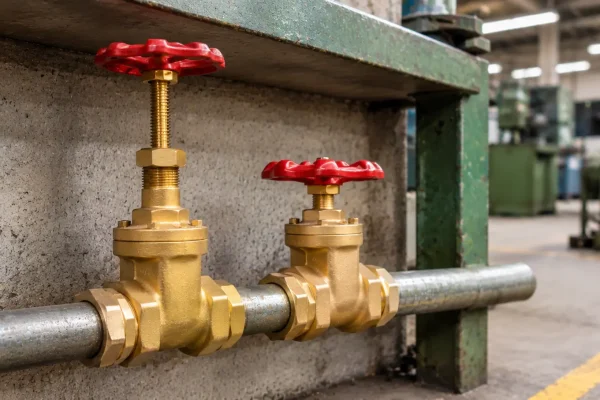


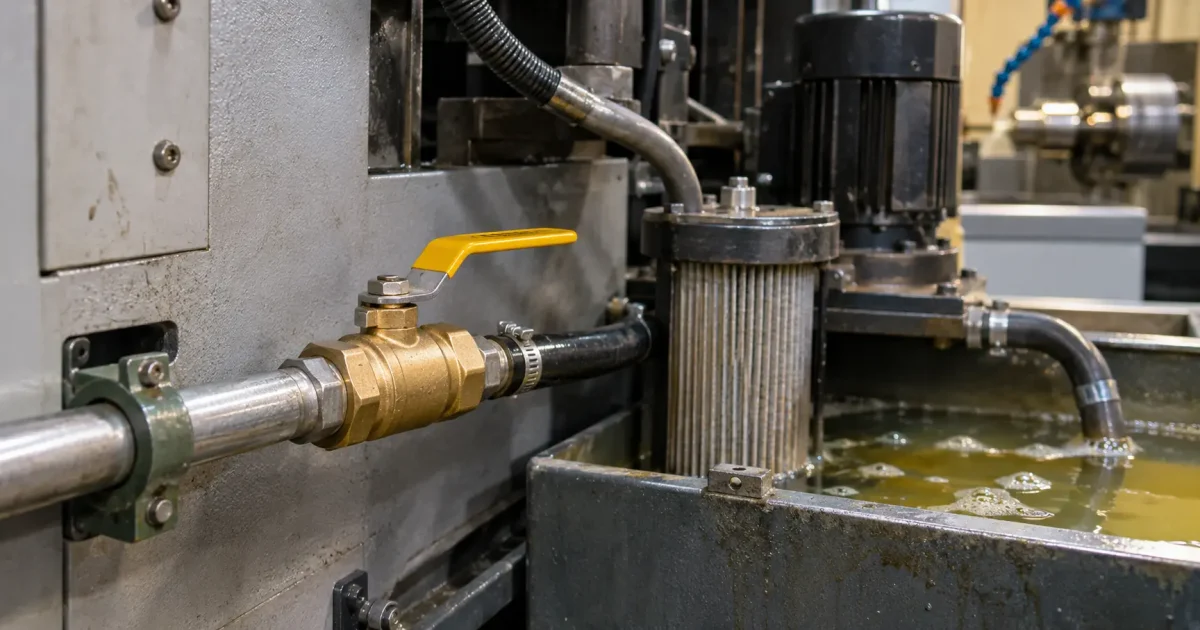
Rajkot’s machine shops cut a great deal of metal. Engine components, bearing races, machine tool castings and agricultural implement parts all go through turning, milling, drilling and grinding, and almost all of that runs with coolant. Coolant reaches each machine through small-bore piping from a machine sump or a central coolant system, with ball valves isolating each branch.
Those valves are usually brass, because brass is what the stores have. This article asks whether a KITZ SZA brass ball valve for coolant lines is the right choice, and when stainless steel is the better one. It covers coolant service only.
What the SZA brings
The KITZ SZA brass ball valve is a Type 600, full bore, forged brass valve with PTFE seats, an FKM stem O-ring and BS21 or NPT threads. Concorde’s product page rates it at 600 psi WOG at ambient temperature and lists water and oil among its services.
That covers most coolant duty in principle. Coolants are either water-based fluids or oils, they run close to room temperature, and the pressures on ordinary flood coolant lines are modest. The question is not whether brass can carry coolant, but whether it suits the specific coolant in your shop.
Straight cutting oils: brass is generally fine
Neat cutting oils are among brass’s easiest duties. They do not corrode it, the PTFE seats and FKM stem seal handle oil well, and the smooth full bore passes the oil without restriction. For straight-oil machines, the SZA is a sensible, economical choice.
Water-miscible coolants: check the chemistry
Soluble oils, semi-synthetics and synthetics are mostly water, with additives that control corrosion, foaming and bacteria. Many use amine-based chemistry to keep the fluid alkaline. Some amine-containing fluids can attack copper alloys over time, which is why many coolant manufacturers add yellow-metal corrosion inhibitors and state copper-alloy compatibility on their datasheets.
The practical step is simple. Look up your coolant’s datasheet and check what it says about copper, brass or “yellow metals”. If it is stated as compatible, brass valves are reasonable. If it warns against copper alloys, or says nothing, either ask the coolant manufacturer or use stainless steel valves on that circuit.
Coolant condition matters as much as coolant type
A coolant that was compatible when new can become aggressive when it is neglected. Bacteria grow in a poorly maintained sump, the fluid turns rancid, and its pH drops. Tramp oil and fines build up. A coolant in that state is harder on every metal it touches, brass included.
If brass valves in one shop keep tarnishing, weeping or seizing while identical valves elsewhere stay clean, look at coolant concentration and condition before blaming the valves. Regular concentration checks and sump cleaning protect the valves as well as the tools.
Swarf and fines
Coolant carries fine metal particles and grinding swarf, even after filtration. Those particles can score the ball and seats, especially if a valve is left part open. The SZA’s full bore helps by leaving no step where fines can settle. Good filtration upstream, and valves kept fully open or fully shut, make the biggest difference.
High-pressure coolant
Many machines have both a low-pressure flood circuit and a high-pressure system for through-tool or through-spindle coolant. The high-pressure side needs separate checking. Compare the pump’s maximum pressure with the valve’s rating at the actual temperature, rather than assuming a valve that suits the flood line will also suit the high-pressure line.
Where the valves sit on a coolant circuit
A typical machine coolant circuit has isolation valves at the pump outlet, on branches to individual nozzles or manifolds, and sometimes at the filter. On a central system there are more: at each machine take-off, on the return lines and around the filtration unit. The take-off and return valves on a central system are the most important to get right, because a failure there affects every machine downstream. If you are mixing brass and stainless across a shop, put stainless at those points first.
Valves on coolant lines are also easy to forget during maintenance. Include them in machine PM checklists: operate each one fully, look for weeping at the stem and joints, and check that the handle still reaches its stops.
When to choose stainless steel
Choose stainless steel valves where:
- the coolant datasheet warns against copper alloys, or the manufacturer cannot confirm compatibility;
- the circuit uses an aggressive synthetic or is hard to keep in good condition;
- the coolant system shares piping or dosing with water treatment chemicals;
- a valve failure would be expensive, for example on a central system feeding a whole line of machines.
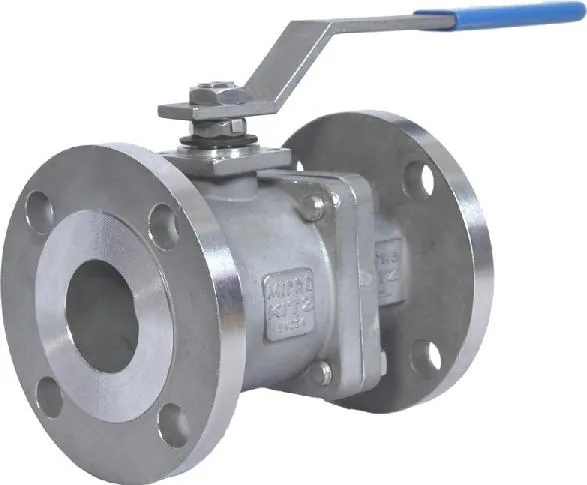
The KITZ ball valve range includes stainless steel families in SCS13A and SCS14A for those circuits. For a general guide to matching ball valve materials to a duty, see our article on choosing the right KITZ ball valve.
To check brass or stainless for your coolant, send the coolant type, its datasheet and the circuit pressure through our contact page.
FAQs
Can KITZ SZA brass ball valves be used on neat cutting oil?
Generally yes. The SZA lists oil among its services, and its PTFE seats and FKM stem O-ring handle oils well. Straight cutting oils do not corrode brass, so the SZA is an economical choice for straight-oil machines.
Are brass valves safe with water-soluble coolants?
Often, but not always. Some amine-based coolants can attack copper alloys over time. Check the coolant datasheet for copper or yellow-metal compatibility. If it warns against copper alloys or says nothing, confirm with the coolant manufacturer or choose stainless steel.
Why are the brass valves in one shop corroding while others are fine?
Look at the coolant’s condition. A neglected sump with bacterial growth, low pH or high tramp oil becomes more aggressive to metals. Check concentration and sump hygiene before replacing the valves.
Does the same valve suit the flood and high-pressure coolant lines?
Not automatically. Check the high-pressure pump’s maximum pressure against the valve’s rating at the operating temperature. A valve that suits the low-pressure flood circuit may not have enough margin for through-spindle coolant.
Should coolant line valves be fully open during machining?
Yes. Use the valve to isolate, not to set coolant flow. A part-open ball valve lets swarf and fines erode the ball and seats. Set flow at the nozzle, a dedicated flow valve or the pump, and keep the isolation valve fully open or fully shut.