


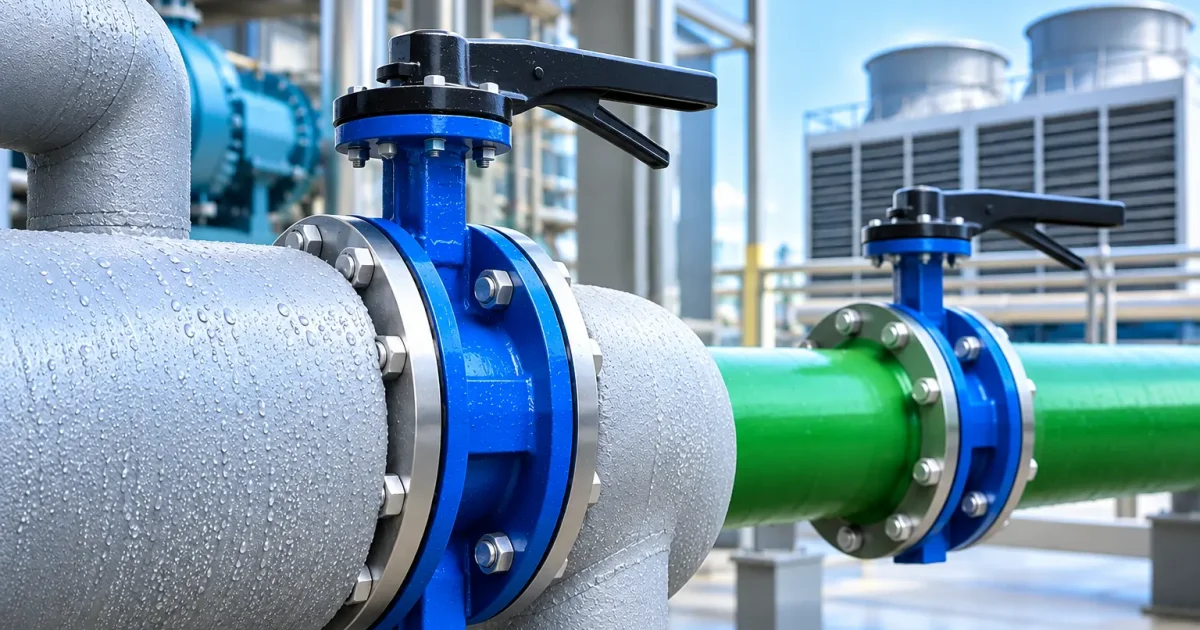
A cast iron butterfly valve on a treated water main will run fifteen years and give nobody any trouble. The same valve, same seat compound, same epoxy coating, installed on a chilled water riser in a commercial building, can be passing or seized inside three. Nothing about the valve changed. The duty did.
The usual reaction is to blame the valve, or the supplier who sold it. The more useful question is which mechanism is actually doing the damage, because HVAC service attacks a butterfly valve in four quite separate ways, and only one of them involves the wetted parts most people inspect first.
Chilled water and condenser water are not the same duty
This is where most of it starts. A specification is written for “HVAC valves”, one product gets selected for the whole plant room, and it goes into two loops that have almost nothing in common chemically.
The closed chilled water loop
Supply temperature is typically 5 to 12 degrees C. The water is treated, the loop is closed, and once it has passivated the dissolved oxygen is low. Many loops carry a glycol mix for freeze or burst protection. Chemically, this is mild water, and the valve’s internals have an easy life.
The problem is the temperature. A valve body on this duty sits permanently below the dew point of the plant room it stands in. Everything difficult about chilled water happens on the outside of the valve.
The open condenser water loop
Cooling tower water is the reverse case. It is aerated by design, so dissolved oxygen sits near saturation. Evaporation concentrates whatever came in with the make-up water, so chlorides climb with the cycles of concentration. It is dosed with biocide and scale inhibitor, and it picks up airborne dust across the tower fill. Operating temperature is near ambient, so there is no condensation problem at all.
One loop is mild water at a temperature that attacks the valve from outside. The other is aggressive water at a temperature that does not. Specifying a single valve build for both means one of the two is wrong.
On chilled water, the failure usually starts outside the valve
This is the part that gets missed, and it is worth being specific about why.
Chilled water sits inside the corrosion window
Corrosion under insulation is well documented in process piping, and the mechanism needs three things: an iron surface, water, and oxygen. On carbon steel it is understood to occur from roughly 0 to 150 degrees C, with the most aggressive band well above ambient, where moisture is present but not yet evaporating. Chilled water at 5 to 12 degrees C is inside that window at the lower end.
Cast iron is not carbon steel, and the published temperature bands are quoted for steel rather than iron. But the mechanism is the same three ingredients, which is why a cold, wet, insulated iron body behaves the way it does in practice.
Below freezing, corrosion rates actually drop, because ice restricts both oxygen and heat transfer. Chilled water gets no such relief. It is cold enough to condense moisture continuously and warm enough for that moisture to stay liquid and keep carrying oxygen to the metal.
It gets worse, because a below-ambient system does not merely get wet by accident. The vapour pressure difference actively drives water vapour inward through the insulation, where it condenses on the cold surface underneath. The insulation does not keep the valve dry. Without an intact vapour barrier it keeps the valve wet.
The insulation detail nobody draws
Pipework gets insulated with a vapour retarder over it, and on a straight run that works. Then the drawing reaches a butterfly valve, which has a lever or a gearbox projecting out of the top flange.
The insulation has to be interrupted around that neck. That interruption is a deliberate hole in the vapour barrier, located at the coldest accessible point in the system. In practice it is made worse by ordinary site work: mastic vapour retarders applied thinner than specified, or with enough pinholes to admit vapour as soon as the system cools down; reinforcing fabric left out, so operating stresses crack the retarder; and jacketing fixed with screws, which puncture the membrane, where bands would not.
What you end up with is a continuous moisture path to the valve body, the stem and the gear train. The sequence is predictable. The stem corrodes and the valve gets stiff, then stiffer, then needs two people on the gearbox. The gearbox internals rust. The body corrodes under the coating, starting from the coating’s edges, which are at the flange faces and around the top flange.
Then somebody opens the valve up, finds the seat in reasonable condition, concludes it was a bad valve, and fits exactly the same thing again.
What actually changes the outcome
Four things, in rough order of how much difference they make for the money:
An extended neck or stem extension. This raises the operating point clear of the insulation line so the insulation and its vapour barrier can carry over the valve body uninterrupted. It is the single detail that addresses the root cause rather than the symptom. It is a build option rather than a shelf item, so it has to be called out at enquiry stage, with the insulation thickness, or it will not be in the quote.
Stainless steel stem and disc as a minimum. On our cast iron butterfly valve range the disc options are ductile iron, stainless steel and aluminium bronze. On insulated chilled water, the ductile iron disc is false economy – a corroding disc edge is what eventually cuts the seat.
Fusion bonded epoxy rather than polyester wherever the valve will be insulated. Both are offered on the range. FBE is the more durable film on a surface that will be permanently damp.
A different body material where the detailing cannot be trusted. On risers, ceiling voids and anywhere insulation will be cut and re-made by whoever is doing maintenance that year, the mechanism is best removed rather than managed. A stainless steel butterfly valve in SS304 does that, and an aluminium butterfly valve is the lighter and usually cheaper route to the same result on smaller chilled water branches. The cost difference against repeated access to a ceiling void is rarely close.
One thing not to do: do not insulate the gearbox or the actuator. It needs to breathe and to be inspectable. Insulate up to the extended neck and leave the operator in open air.
What the water does to the seat
Glycol is harder on rubber than water is
Glycol mixtures are chemically aggressive toward elastomers that are not formulated for the service. Standard rubber compounds can swell, harden or creep, and any of the three will cost you shutoff. Across long-term water and glycol service, seat deterioration is the most common butterfly valve failure point.
EPDM is the right starting point, matched to the glycol type and the concentration actually in the loop rather than the one on the original drawing. Our range offers EPDM, NBR, Viton and PTFE seats, and for a glycol chilled water loop the answer is EPDM.
NBR is the one to avoid here, and it gets picked more often than it should because it is familiar and cheap. NBR is an oil-resistant elastomer. Glycol-water is not its service, and a loop that runs for years on an NBR seat will usually show it as a slow loss of shutoff rather than a sudden failure, which makes it hard to attribute.
It is also worth knowing which glycol you have. Propylene glycol is preferred where there is any human exposure risk; ethylene glycol performs better at the lower end of the temperature range. The seat has to suit whichever one is in the system.
Open loop water is both a seat and a body problem
On the condenser side the chemistry does the damage. Full oxygen saturation, chlorides concentrated by evaporation, and biocide dosing.
Dosing is the part that catches people out. The loop runs at a low residual most of the time, and then takes a shock dose well above it. An elastomer responds to the peaks, not the average, so a seat selected against the average residual is being specified against a number the valve never actually sees.
For an open loop, a stainless steel disc is the minimum, not an upgrade. On make-up and blowdown lines, where flow is intermittent and water stands in the valve between operations, a stainless body earns its cost. Those are the valves that fail first on most cooling tower installations, and they are usually the smallest and cheapest ones in the package.
A seat that never moves takes a set
Resilient seats are designed to be worked. A well-designed seat lets the rubber compress and flow into the body groove as the valve cycles. Held in one position for long enough, it compresses and does not fully recover.
Open the valve up after three untouched years and there is a flat on the liner where the disc edge has been sitting. The first operation after that deforms or tears it along that line, and the valve starts passing — not because it was operated, but because it was not.
In Indian commercial buildings this has a seasonal shape to it. The chiller plant is shut for part of the year, isolation valves sit in one position for months, and the plant room stays humid throughout. The valve that fails on start-up in March was damaged during the months it did nothing, not on the morning it was turned.
The remedy is dull and it works: exercise the isolation valves. Full open to full closed and back, once or twice a year, written down. For a plant room it is an afternoon’s work, and it also finds the stems that have started to seize while they can still be freed.
Shaft sealing is worth a look at the same time. Leakage past the shaft area is a failure mode that standard commercial valves often under-address, and a secondary shaft seal is a reasonable thing to ask about on a valve that will be insulated and difficult to get back to.
Butterfly valves used as balancing valves
This one is a specification problem rather than a valve problem. Balancing valves come out of the budget, so the branch isolation valve gets left part open to set the flow instead.
A butterfly valve’s stable control range is roughly 30 to 70 percent open. Below about 30 percent, downstream turbulence increases sharply, which erodes components and makes the control unstable. Below roughly 10 percent on a large valve, control authority is effectively gone — small movements of the disc produce large, unpredictable changes in flow.
A resilient-seated valve parked at 15 or 20 percent open is taking the full line velocity across the disc edge and across the seat immediately behind it, continuously, for years. It also holds a steady load on the stem and the gear train that neither was sized for.
If the branch needs balancing, balance it with a device built for the job and keep the butterfly valve for isolation. If it genuinely has to throttle, keep it inside the 30 to 70 percent band, specify a stainless disc, and treat the seat as a wear part with a replacement interval rather than a lifetime component.
Dead-end service on equipment take-offs
The last mechanism is mechanical and it shows up the first time somebody services a pump.
A wafer body has no flanges of its own. It is clamped between two pipe flanges on through-bolts, and it relies on the downstream flange to hold both the valve and its gaskets in place. Remove the downstream pipework to pull a pump or drop an AHU coil, and the valve has lost half of what was holding it.
A lug type body has threaded inserts, so it can be bolted from one side and will hold pressure with the downstream side completely open. That is exactly what an isolation valve on serviceable equipment is for.
The cost difference between wafer and lug is small. The cost of draining a riser because the isolation valve could not be trusted on its own is not. Where a valve is there specifically so that something downstream can be removed, specify lug, and ask for the dead-end pressure rating, which is normally lower than the valve’s line rating and should be stated rather than assumed.
What to put on the enquiry
For a closed chilled water loop:
- Glycol type and concentration, not just “chilled water”
- Insulation thickness, so an extended neck can be quoted to suit it
- EPDM seat, confirmed against the glycol actually in the loop
- Stainless steel stem and disc
- Fusion bonded epoxy coating where the valve will be insulated
- Lug body wherever downstream equipment will be removed, with the dead-end rating stated
- Whether the valve will ever be used to throttle, and if so, between what positions
For an open condenser or cooling tower loop:
- Biocide type and peak dosing residual, not the average
- Make-up water chloride level, and the cycles of concentration the tower runs at
- Stainless steel disc as standard
- Stainless body on make-up, blowdown and any line where water stands between operations
- No extended neck needed, since the loop runs near ambient
Worth asking for on either loop: the seat test certificate with the leakage class stated, and confirmation of the test standard the valve was shut-off tested to. API 609 covers butterfly valve design; API 598 is the valve inspection and testing standard, and a valve tested drip-tight before despatch is a different proposition from one that was not. If a supplier cannot produce the document, that tells you something before the valve is in the wall.
FAQs :-
Can I use the same butterfly valve on chilled water and condenser water?
You can, but one of the two will be wrong. The chilled water valve needs protection against condensation and an insulation-compatible build. The condenser water valve needs corrosion resistance against aerated, chloride-bearing, chemically dosed water and needs nothing at all for condensation. Specifying the same build for both usually means buying condensation protection you do not need on the tower side, and skipping corrosion resistance you do need there.
Is EPDM or NBR the right seat for a glycol chilled water loop?
EPDM, matched to the glycol type and concentration in the loop. NBR is an oil-resistant elastomer and glycol-water is not its service — it tends to lose shutoff gradually rather than failing outright, which makes the cause hard to trace later. Confirm the glycol with the operator rather than taking it from the original design document, because concentrations get adjusted over a system’s life.
Why is my chilled water butterfly valve stiff to operate when the seat looks fine?
Almost always the stem, and almost always from the outside. Condensation reaching the stem and the gear train through a broken vapour barrier corrodes both, and that happens whether or not the seat has seen any wear. If the valve is hard to turn but holds shut, look at the stem and the gearbox before you look at the seat, and look at the insulation around the neck before either.
Do I need a stainless steel body for chilled water, or is cast iron acceptable?
Cast iron is acceptable on chilled water where the insulation and vapour barrier are properly detailed around an extended neck and the valve can be reached for inspection. Where either of those is in doubt — risers, ceiling voids, anywhere insulation will be cut and re-made over the building’s life — stainless steel or aluminium removes the failure mechanism instead of managing it, and usually costs less than two access visits.
How often should chilled water isolation valves be exercised?
Once or twice a year, full open to full closed and back, with it logged. Seats that stay in one position compress and take a set, and a valve that has not moved for years will often start passing immediately after its first operation. Annual exercising also catches a seizing stem while it can still be freed by hand.
Should the valve be insulated along with the pipe?
The body should be, with the vapour barrier continuous over it, which is what an extended neck exists to allow. The gearbox, lever or actuator should not be. It needs to stay accessible and inspectable, and enclosing it traps moisture against the part you least want corroding.
