

Table of Contents
- What the pulse is actually doing
- Air-to-cloth ratio sets the ceiling
- Cleaning frequency is the lever you control day to day
- Pulse sequence: the setting almost nobody adjusts
- Pulse pressure is a setting, not a fixed value
- What quietly shortens bag life
- Reading the differential pressure trend
- Where to start
- Frequently asked questions
- How long should filter bags last in a pulse jet collector?
- Will reducing pulse pressure make cleaning worse?
- Should cleaning be triggered by a timer or by differential pressure?
- Does pulse order really affect bag life?
- Why is differential pressure high straight after a bag change?
- What does a sudden drop in differential pressure mean?
Filter bags are the recurring cost of running a baghouse. The collector is bought once. The bags come round again and again, and on a unit carrying a few hundred of them, a replacement cycle is a real line in the maintenance budget. Anything that shortens bag life shows up directly on that number.
The useful thing to know is that bag life is mostly decided by how the collector is operated, not by which bag was purchased. Two identical collectors running the same media can differ by years.
What the pulse is actually doing
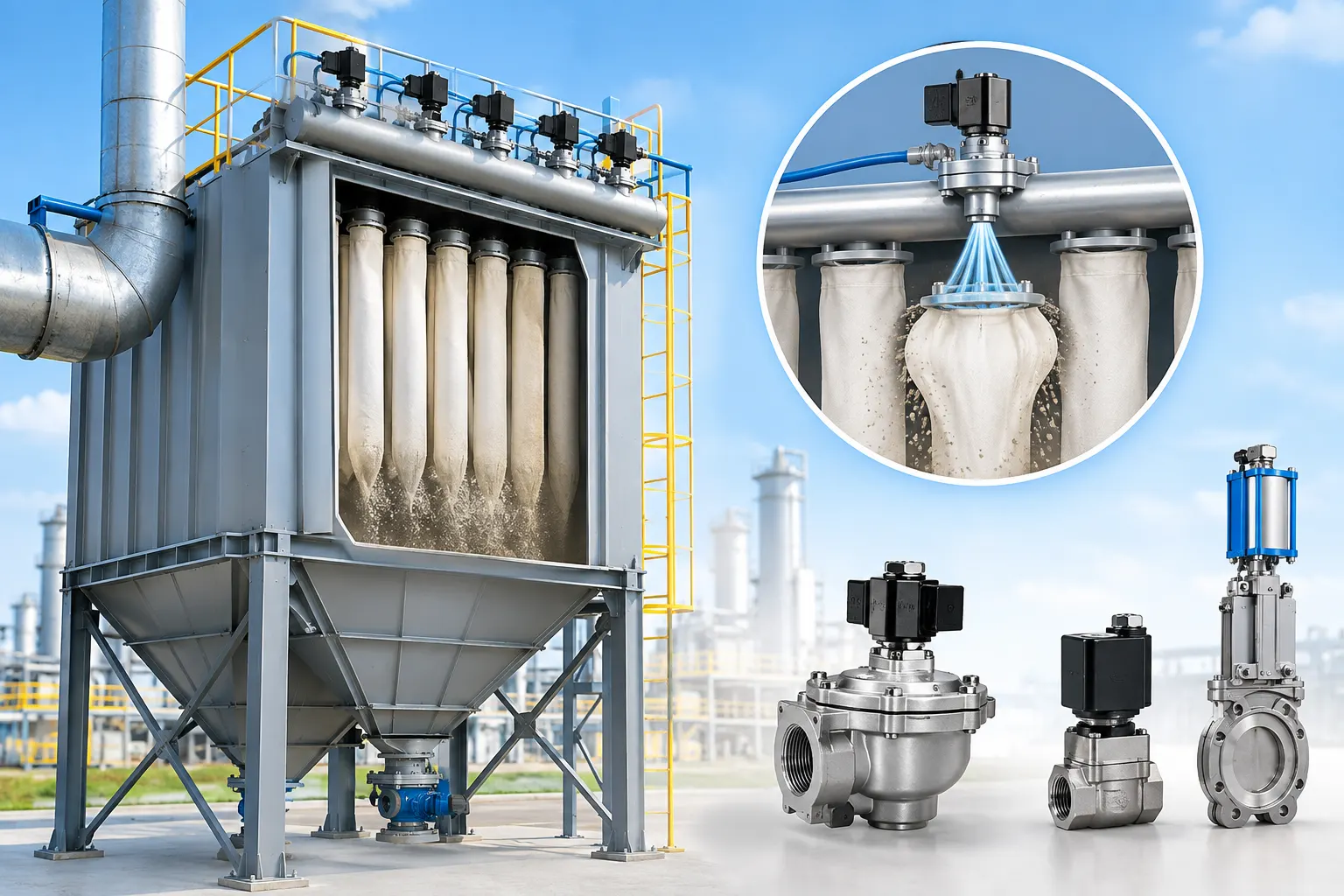
A pulse jet collector cleans by firing a short burst of compressed air down the inside of the bag, typically lasting in the order of a tenth of a second. The bag snaps outward, the dust cake cracks, and the bag settles back.
Two things follow from that, and the second one is usually overlooked.
The first is obvious enough. Every pulse is a mechanical shock applied to the fabric. Good pulse jet valves are designed for this duty and some are rated for up to a million cycles. The bags are not. Each pulse flexes the media at the same points, particularly near the top where the cage supports it, and the more violent the flex, the faster the fabric fatigues. Fewer and gentler pulses means longer bag life.
The second is that the pulse only interrupts forward gas flow for a fraction of a second. As soon as it stops, forward flow resumes and carries a good portion of the dislodged dust straight back onto the bag that was just cleaned, or onto the bags next to it. This has a downside and an upside. It works against dust actually reaching the hopper, but it also reforms the dust cake quickly.
That matters because in a pulse jet collector the dust cake is doing much of the filtering, not the fabric alone. Strip a bag completely clean and it filters worse until a new cake builds. Over-cleaning does not just waste bag life, it temporarily costs you collection efficiency.
Air-to-cloth ratio sets the ceiling
Air-to-cloth ratio is airflow divided by total filter area, which works out as a face velocity through the media. It decides how hard the dust is driven into the fabric, and it is the single biggest constraint on bag life.
Pulse jet collectors run at roughly double the ratio of shaker or reverse-air designs, which is why they need felt or needled media rather than woven fabric. The felt construction takes the high-energy cleaning and plays an active part in filtration. Typical recommended ratios for pulse jet units fall in the region of 3.25:1 to 4:1, though the correct figure depends on the dust and the media.
Run above the design ratio and the dust stops sitting on the surface where a pulse can release it. It embeds into the fabric structure. Once that happens the pulse cannot recover it, differential pressure climbs permanently, and the bag is finished long before its rated life. This is the most common reason bags fail early, and no change of valve or pulse setting fixes it.
One practical point that catches people out: calculate the ratio using actual cubic feet per minute at operating conditions, not standard conditions. On a hot gas stream the difference is significant, and a collector sized on the wrong figure runs harder than the design sheet suggests.
If the collector has been debottlenecked, had the fan upgraded, or had extra pick-up points added since installation, recalculate the ratio before investigating anything else.
Cleaning frequency is the lever you control day to day
Most collectors ship with a timer-based controller. It fires each row at a fixed interval regardless of what the differential pressure is doing. On a light production shift, or during a shutdown when the fan runs but no dust is being generated, it keeps pulsing anyway.
That spends compressed air and bag life on nothing.
Switching to clean-on-demand, where cleaning is triggered by differential pressure rather than a clock, means the collector cleans when there is actually a cake to remove. A pressure switch starts the cycle at a high set point and stops it once pressure has come down to the low set point. Plants making this change commonly report compressed air consumption falling by around 20 to 30 percent, and the reduction in pulse count feeds straight through to bag life.
Compressed air is usually the most expensive utility on a plant, so the change often pays back on air alone. The extra bag life is the part that never appears in the energy calculation.
As a reference band, many pulse jet collectors are set to hold differential pressure around 3 to 6 inches water column depending on media type, with a fairly narrow gap between the high and low set points, in the region of half an inch to one inch. Too wide a band and the collector swings between over-cleaned and blinded.
Pulse sequence: the setting almost nobody adjusts
Here is a detail that rarely comes up and costs nothing to change.
If rows are pulsed in strict sequential order, each freshly cleaned row sits immediately next to the row about to be cleaned. The fine submicron material dislodged from one row migrates straight onto its neighbour, which has just been cleaned and has no protective cake yet.
Staggering the pulse order so consecutive pulses hit rows that are physically apart puts distance between cleaned rows and those still to be cleaned. The dust cake forms more evenly, filtration improves, and because the collector holds its pressure better, the cleaning frequency can often be reduced. Lower frequency means longer bag life.
If your controller allows a custom sequence, it is worth setting up.
Pulse pressure is a setting, not a fixed value
There is a habit of running pulse pressure as high as the header allows, on the assumption that a harder pulse cleans better. Past a point it does not. It simply flexes the media more violently and wears it faster, while using more air than the job needs.
Many collectors clean effectively at lower pressures than they are set to. Low-pressure pulse systems operating around three to five bar rather than seven to eight bar are widely used, with energy savings in the region of 15 percent and no loss of cleaning effect. The right setting depends on bag length, dust characteristics and cleaning geometry, so establish it by test: reduce in steps and watch whether the differential pressure baseline holds.
Aim for a short, crisp pulse rather than a long soft one. Two mechanical factors decide that as much as the pressure setting. The valve needs fast diaphragm action so the burst arrives sharply, and the discharge path needs adequate internal diameter, because an undersized fitting throttles the pulse no matter what the header gauge reads.
The pilot circuit matters too. A pulse valve is triggered by a solenoid, and a sluggish or undersized pilot gives a lazy pulse regardless of how good the main valve is. On circuits with little differential pressure to work with, this is where a 2/2 way low pressure diaphragm type solenoid valve earns its place, because a conventional pilot-operated valve needs a minimum differential to open at all.
What quietly shortens bag life
Moisture in the compressed air is the big one. Condensate carried into the pulse header reaches the bag as wet air and turns dust into a paste that will not release. Keep the pulse air dry and oil-free, and fit proper drain points and separators on the header. An air line non return valve helps here as well, since a free-floating ball will not jam on the scale and rust particles a compressed air line inevitably carries.
Bag-to-cage fit is next, and it is a wear problem rather than a cleaning one. A bag flexing against a broken cage wire or a rough weld wears through at that point in months. Cages should be the right length, undamaged, and smooth where the fabric touches them.
Then there is cleaning during shutdown, which moves dust around inside the collector and re-deposits it without the airflow to carry anything to the hopper. Operating above the media temperature rating degrades the fibre regardless of anything else.
And hopper build-up means dislodged dust gets re-entrained and filtered a second time, so the bags do the same work twice. That last point is worth following through, because hopper discharge on a dusty collector usually runs through a knife gate valve. If that valve is not sealing or not clearing fully, the hopper backs up and the bags pay for it. On automated lines the same duty is handled by a pneumatic operated knife gate valve, or an electric knife gate valve where the discharge is remote or cycled infrequently.
Reading the differential pressure trend
A single differential pressure reading tells you little. The trend over weeks tells you almost everything, and tracking it by compartment where the collector is compartmented tells you more again.
A steady sawtooth that rises between pulses and drops after each one is a collector working correctly. A baseline that creeps upward over weeks and no longer returns to its previous low point means the cake is no longer fully releasing, which points to embedding, moisture or under-pulsing. A sudden drop usually means a bag has ruptured or a clamp has come loose and air is bypassing the media altogether.
That trend is the cheapest predictive maintenance available on a dust collector. It gives weeks of warning before a bag change becomes an emergency, and it tells you which of the causes above you are actually dealing with.
Where to start
If bags are falling short of expected life, work through it in this order. Recalculate the air-to-cloth ratio at actual operating conditions, because nothing downstream helps if that is wrong. Check the pulse air for moisture. Inspect cages for damage and fit. Then move to the controller: switch from timer to differential pressure triggering, stagger the pulse sequence, and work the pulse pressure down in steps while watching the trend.
Most of those cost nothing but time.
Concorde Valves & Automations manufactures pulse jet valves for bag filter and cartridge collectors from Mumbai, supplied across India, along with the diaphragm operated solenoid valves used in the pilot circuit, so the cleaning system can come from one source. ISO 9001:2015 certified, with material test certificates available on request. Tell us your collector type, bag count and header pressure and we will recommend a valve. If the problem you are describing is a sizing issue rather than a valve issue, we will say so. Request a quotation and we will respond within 24 hours.
Frequently asked questions
How long should filter bags last in a pulse jet collector?
Standard polyester bags typically run one to three years and PTFE-coated media three to five. Where bags fall well short of that, the cause is usually air-to-cloth ratio, moisture in the pulse air or excessive cleaning frequency rather than the bag itself.
Will reducing pulse pressure make cleaning worse?
Not necessarily. Many collectors clean effectively at lower pressures than they are set to. Reduce in steps and watch the differential pressure baseline. If it holds steady, the lower setting is doing the job with less wear on the fabric.
Should cleaning be triggered by a timer or by differential pressure?
Differential pressure, on any collector large enough to justify the controller. It pulses only when there is a cake worth removing, which saves compressed air and reduces the number of flex cycles the bags see.
Does pulse order really affect bag life?
Yes, indirectly. Pulsing adjacent rows in sequence lets fine dust migrate onto the row that was just cleaned. Staggering the order improves cake formation and often allows a lower cleaning frequency, which is what extends bag life.
Why is differential pressure high straight after a bag change?
New media needs to build a light seed cake before it filters efficiently, so a short settling period is normal. If pressure stays high beyond that, check the air-to-cloth ratio and confirm the pulse is reaching every row.
What does a sudden drop in differential pressure mean?
Usually a ruptured bag or a loose clamp letting air bypass the media. Check for dust carry-over at the outlet and inspect the suspect row.