

Rajkot’s engineering units, which make diesel engines, bearings, machine tools and agricultural implements, run on compressed air. It powers impact wrenches and grinders, blows down machined parts, and feeds pneumatic clamps and fixtures on CNC machines. Air reaches each point through a branch drop off the main header, and almost every drop ends in a small isolation valve.
That valve gets little attention when it is fitted and a lot when it fails. This article covers choosing and fitting a KITZ micro ball valve for compressed air drops and machine feeds, and the mistakes that cause most problems. For how ball valves are built in general, see our ball valve page.
Why a micro ball valve suits air drops
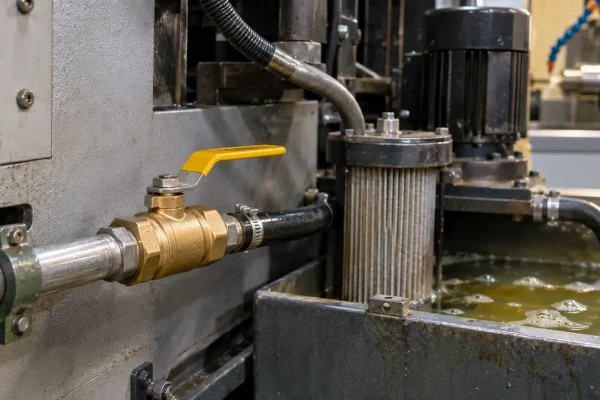
KITZ micro ball valves are compact quarter-turn valves with brass or stainless steel bodies and PTFE seats. Concorde’s product page positions brass for water, air and light industrial use, which makes brass the normal choice for workshop air. They come in mini lever and compact versions for tight spaces, with threaded or compression ends, and in female-by-female and male-by-female forms.
On an air drop, the quarter-turn action and visible lever position are what matter. A fitter can see from a distance which drops are live, and isolate one in a second.
Mistake 1: not checking the pressure rating
The product page says brass micro ball valves typically handle up to 10 bar, depending on series and size. Many workshop systems run below that, but the compressor’s cut-out pressure, not the gauge reading on a normal day, is the figure to check. Confirm the rating for the exact model against your system’s maximum pressure. If the system runs close to the limit, choose a model with more margin or a stainless version.
Mistake 2: mixing thread standards
Workshops collect fittings from many sources, so BSP and NPT threads end up in the same bin. They look similar and will start to engage, but they do not seal properly together. The result is a slow leak that wastes compressed air, often with a hiss nobody notices over machine noise. Know which thread your drop and your FRL use, and order the valve to match.
Mistake 3: too much sealant, applied badly
PTFE tape wrapped over the end of a thread, or too much liquid sealant, gets pushed into the air stream. Fragments end up in the regulator, the solenoid valves or the tool. Keep tape back from the first thread, wrap it in the direction of the thread, and use only what the joint needs.
Mistake 4: over-tightening the body
Brass is relatively soft. A fitter putting a long spanner on a small valve body can distort it or crack a female thread, and the leak appears later. Hold the valve by the flats nearest the joint being tightened, and do not use the valve body to lever a fitting round.
Mistake 5: the valve in the wrong place
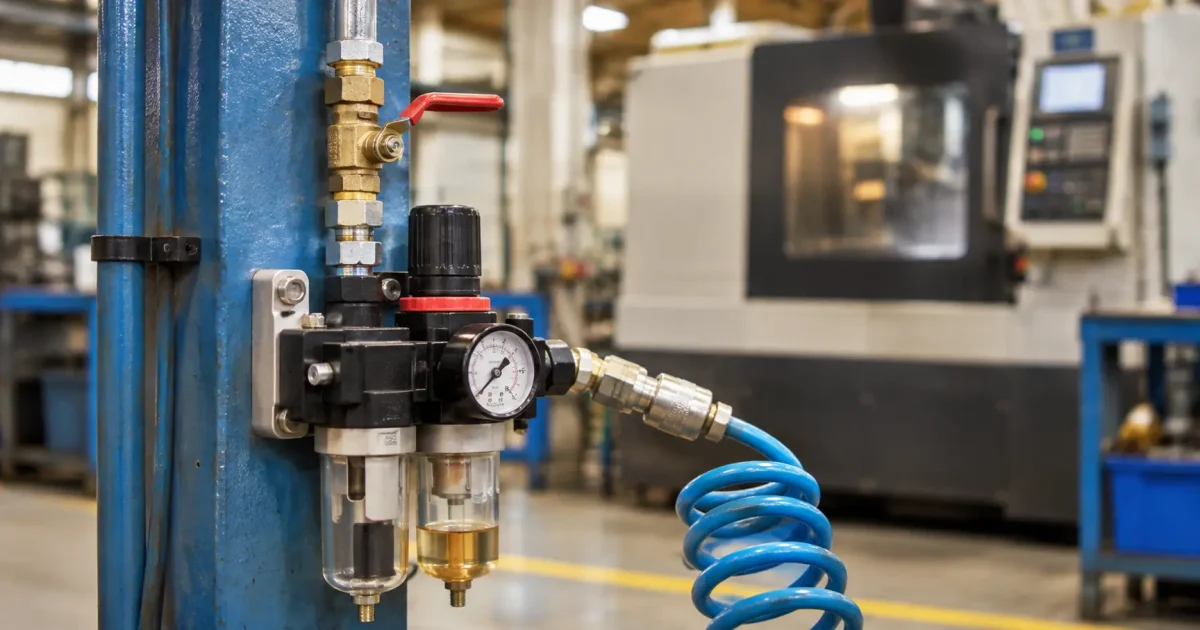
The isolation valve belongs upstream of the filter-regulator-lubricator, not after it. With the valve upstream, the FRL can be serviced, the filter bowl changed and the regulator replaced without shutting down the header. A valve downstream of the FRL isolates the tool, but not the parts that need maintenance most often.
Mistake 6: no way to vent the downstream side
Closing a valve does not empty the hose. The tool, hose and FRL downstream are still at full pressure. Uncouple that hose and it whips. Use a 3-way configuration, which is on the product page, or a separate small vent, so the downstream side is depressurised before anyone disconnects anything.
Mistake 7: using the valve as a regulator
If a tool runs too hard, the fix is the regulator, not a half-open ball valve. A valve held part open wears its seat and still lets full pressure through when the tool stalls. Keep the micro ball valve fully open or fully shut.
Mistake 8: a lever in harm’s way
A lever sticking out into a gangway gets knocked by trolleys, cranes and people, and can be knocked shut, or half shut, by accident. Orient the valve so the lever lies along the column or pipe when open, and keep it clear of hose couplings.
A quick fitting checklist
- Rating checked against the compressor’s maximum pressure.
- Thread standard matched at both ends.
- Sealant applied sparingly, clear of the first thread.
- Valve upstream of the FRL.
- A way to vent the downstream side.
- Lever lying clear of gangways and hoses.
Running through these six points when each drop is fitted takes a minute and avoids most of the leaks and near-misses that small air valves cause.
For the header and larger branch sizes, see the full KITZ ball valve range. Water in air lines is a separate problem, covered in our article on compressed air condensate drains. To match valves to your drops, send the thread type, size and system pressure through our contact page.
FAQs
Is a brass micro ball valve suitable for workshop compressed air?
Yes, in most workshops. Concorde’s product page positions brass for water, air and light industrial use, and says brass models typically handle up to 10 bar. Check the exact model rating against your compressor’s maximum pressure.
Should the isolation valve go before or after the FRL?
Before it. An isolation valve upstream of the filter-regulator-lubricator lets you service the FRL without shutting down the header. You can fit a second valve after it if individual tools also need isolating.
Why does an air hose whip when I disconnect it after closing the valve?
Because closing the valve leaves the hose and tool still pressurised. Use a 3-way valve or a separate vent to release the downstream pressure before disconnecting.
Can I use the ball valve to reduce air pressure to a tool?
No. Set pressure with the regulator. A ball valve held part open wears its seat and does not control pressure reliably, especially when the tool stalls or stops.
Do I need a stainless steel micro ball valve for compressed air?
Not usually. Brass is the normal choice for workshop air. Stainless steel makes sense where the air line runs in a corrosive atmosphere, where the system pressure is above the brass model’s rating, or where the valve also sees wash-down or chemical splash.