
Table of Contents
- What actually happens when a pump stops
- Why a swing check valve is often the culprit
- What makes a check valve close fast
- Cracking pressure, and the trade-off nobody mentions first
- Orientation matters more than people expect
- When solids are in the line
- What to check before you specify
- Frequently asked questions
Most people meet water hammer before they can name it. A pump trips, and somewhere down the line there is a bang loud enough to be felt through the floor. Do it often enough and you start replacing gaskets, then supports, then sections of pipe. The check valve is usually blamed, and usually it is the right suspect, but not for the reason people assume. The problem is rarely that the valve failed. The problem is that it closed too late.
What actually happens when a pump stops
While the pump runs, the liquid in the discharge line is a moving column with real momentum. When the pump stops, that column does not stop with it. It keeps travelling forward, decelerates, and then reverses as gravity and system pressure push it back towards the pump.
The check valve is there to stop that reversal. The question is how quickly it manages to do so. If the disc is still partly open when the flow has already reversed and picked up speed, it eventually slams shut against a moving column of liquid. All the kinetic energy in that column has to go somewhere, and it converts into a pressure spike that travels along the pipe as a wave.
The magnitude of that spike depends on how fast the velocity changes, the density of the fluid and the speed at which a pressure wave travels through it. The practical consequence is simple enough. A small, gradual change in velocity produces a manageable surge. A sudden arrest of a fast-moving reverse column produces a large one.
Why a swing check valve is often the culprit
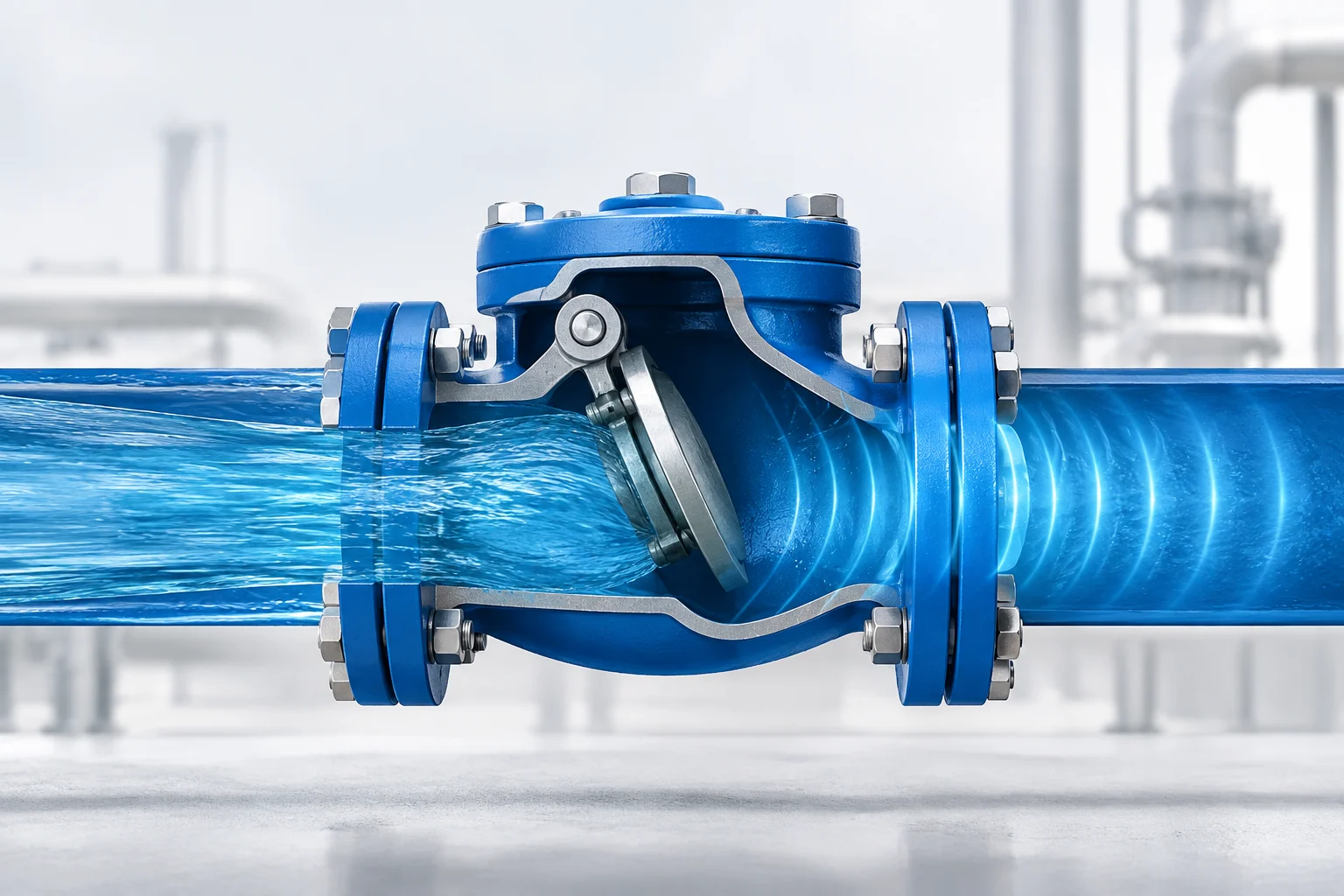
A conventional swing check has a disc on a hinge that travels through a long arc. That arc is the issue. The disc has a considerable distance to cover before it seats, and nothing is driving it except the flow itself. By the time it arrives, reverse flow has had time to establish, and the disc lands hard.
It also means the valve behaves unpredictably. At low flow the disc flutters rather than sitting fully open, which wears the hinge pin and the seat. At shutdown it closes late. Neither is a defect in the valve. It is simply what that geometry does.
What makes a check valve close fast
Three things shorten the closing time, and good non-slam designs use all of them.
Short stroke
The less distance the closing element has to travel, the sooner it seats. A disc that lifts a few millimetres off its seat closes far quicker than one swinging through ninety degrees. This is the main reason a disc check valve behaves so differently from a swing check in the same line.
Spring assistance
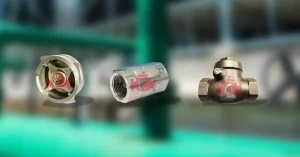
A spring does not wait for reverse flow to begin. It starts closing the disc as soon as forward flow decays, so the valve is already seating while the column is still decelerating. This is the core of the non slam disc check valve design and the reason it is specified on pump discharge lines where surge is a known risk.
Low moving mass
Lighter closing elements respond faster. A dual plate check valve splits the disc into two spring-loaded semicircular plates, each covering a shorter arc with less mass than a single full-bore disc. That is why dual plate valves are classed as non-slam, and why they are common in larger sizes where a single disc would be heavy and slow.
Cracking pressure, and the trade-off nobody mentions first
A spring that closes the valve quickly also has to be pushed open by forward flow. The pressure needed to lift the disc off its seat is the cracking pressure, and it shows up as permanent head loss for as long as the pump runs.
This is the real design decision. A heavier spring gives faster closure and better surge protection, but costs more pumping energy every hour of operation. A lighter spring is cheaper to run but closes later. There is no universally correct answer, which is why the useful question at enquiry stage is not “which check valve is best” but “what is the flow velocity, what is the static head behind the valve, and how often does this pump start and stop”.
Orientation matters more than people expect
A spring-assisted valve works in horizontal or vertical lines because the spring does not care about gravity. A gravity-dependent swing check installed in a vertical line with downward flow will not close reliably at all, and this is a surprisingly common site error.
Wafer type valves add a second consideration. They sit between flanges and rely on those flanges for support, so the pipework alignment has to be right. A wafer check valve installed in a poorly aligned joint will leak regardless of how good the valve is. In cast iron pipework the equivalent is a cast iron wafer check valve, matched to the body material of the line it sits in.
When solids are in the line
Spring and disc designs assume reasonably clean liquid. Put slurry, scale or fibrous solids through them and the disc stops seating because material lodges on the seat face.
For that service a ball type non return valve works better. The ball is free floating and rolls as it seats, so it does not jam on particles the way a hinged disc does. It is slower to close than a spring-assisted disc, so it is not the choice where surge is the primary concern, but on a dirty line it will still be sealing long after a disc check has stopped. Larger lines take the flanged end version of the same design.
On pump suction rather than discharge, the related product is a ball type foot valve, which holds the column in the suction line so the pump does not lose its prime between starts.
What to check before you specify
Flow velocity in the line during normal operation. Static head downstream of the valve, since this is what drives the reverse column. Pump start and stop frequency, because surge damage is cumulative. Pipe orientation and whether flow is horizontal, vertical up or vertical down. Whether the medium carries solids, scale or fibre. Available space, since wafer patterns fit where a flanged valve will not. And the head loss you are willing to accept.
Water hammer is not always solved by the valve alone. Soft-start pump controls, surge vessels and air release valves all have a role on larger systems. But on most industrial pumping lines the check valve is the cheapest and most direct lever, and choosing the right closing behaviour costs nothing extra at the point of order.
On municipal water and pumping station duty the isolation valve alongside it is usually an ISI marked sluice valve to IS 14846, and it is worth specifying both together so the check valve can be isolated for inspection without draining the line.
Concorde Valves & Automations manufactures check valves and non return valves in wafer, disc, dual plate, non slam and ball type designs from Mumbai, built and tested to API 594, with material test certificates available on request. If you send us the line size, velocity, head and medium, we will tell you which design fits. If a check valve is not the right answer to your surge problem, we will say so. Request a quotation and we will come back within 24 hours.
Frequently asked questions
Does a non slam check valve eliminate water hammer completely?
No. It reduces the pressure surge significantly by closing before reverse flow builds velocity, but on long lines with high static head you may still need surge vessels or controlled pump shutdown alongside it.
What is cracking pressure on a check valve?
It is the differential pressure needed to lift the disc off its seat and allow forward flow. A higher cracking pressure means faster closure and better surge protection, at the cost of higher permanent head loss.
Can a check valve be installed vertically?
Spring-assisted disc and dual plate valves work in horizontal and vertical lines. Gravity-dependent swing checks should not be used in vertical lines with downward flow, since the disc will not seat reliably.
Why does my check valve chatter at low flow?
The disc is not being held fully open, so it oscillates against the flow. It usually means the valve is oversized for the actual duty. A smaller valve, or a spring-loaded design sized for the real flow range, will hold position properly.