
Table of Contents
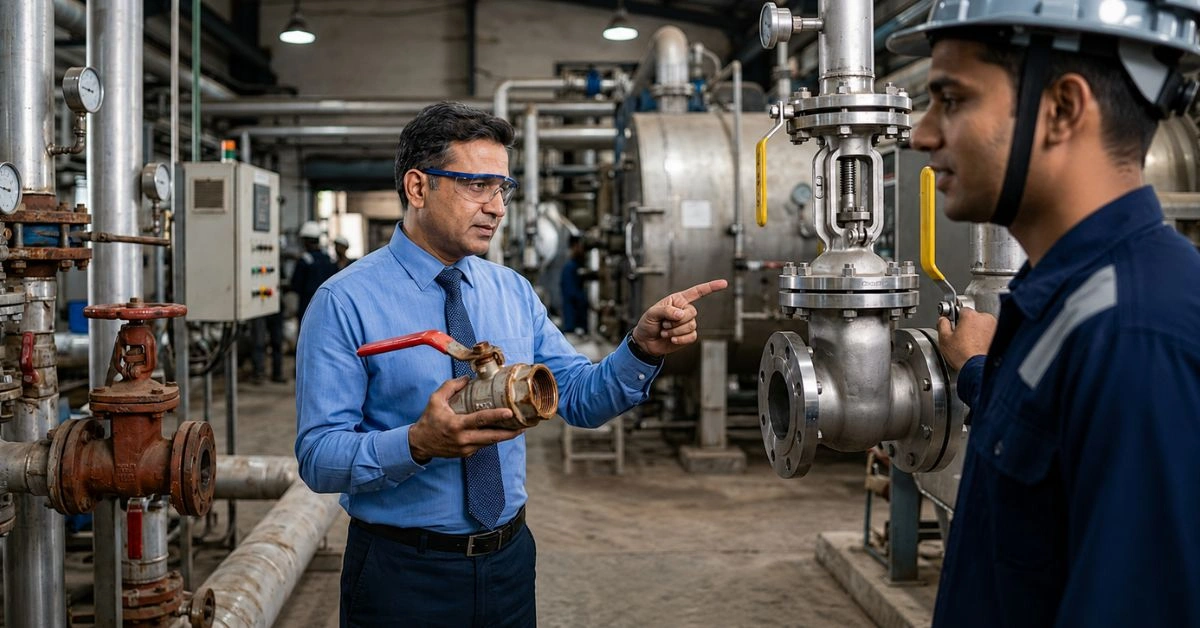
Procurement teams in Indian industries often face one recurring pressure cut costs wherever possible. Valves, being a small line item in a large project budget, are an easy target. Why spend ₹5,000 on a quality ball valve when a cheaper alternative is available for ₹1,200? The logic seems sound on paper. But plant engineers and maintenance heads who have dealt with unplanned shutdowns, pipeline failures, and repeated replacements know the real answer. Cheap valves are rarely cheap. They just delay the cost.
The True Cost of a Valve Goes Beyond the Purchase Price
When evaluating a valve, most buyers look at only one number — the unit price. This is where the mistake begins. The actual cost of a valve over its service life includes installation labour, periodic maintenance, replacement frequency, production downtime during failure, and in worst cases, damage to connected equipment or pipelines. Industry professionals call this the Total Cost of Ownership (TCO), and when you calculate TCO honestly, a low-cost valve almost always loses.
Why Total Cost of Ownership Matters More Than Unit Price
A quality valve from a reputable manufacturer, properly sized and installed, can run for 10 to 15 years with minimal maintenance. A cheaper alternative made from substandard casting or non-conforming seals may need replacement within 18 to 24 months. Multiply that replacement cost by three or four cycles, add downtime losses, and the numbers tell a very different story from what the purchase order showed.
Where Cheap Valves Actually Cut Corners
Not all budget valves fail for the same reason, but the compromises are usually made in predictable places. Understanding where corners get cut helps procurement teams ask the right questions before signing off on a purchase.
- Body material and wall thickness: Low-cost valves often use inferior grade casting with thinner walls, which fail under pressure fluctuation or thermal cycling.
- Seat and seal quality: Cheap elastomers and PTFE seats wear out faster, leading to internal and external leakage far earlier than expected.
- Stem and disc finish: Poor surface finishing on the stem increases friction and wear, causing operational failure in actuated valves.
- Pressure and temperature ratings: Budget valves are frequently mislabelled. A valve marked PN16 may not truly perform at that rating under sustained conditions.
- No third-party testing: Quality valves undergo hydrostatic testing, seat leakage tests, and certification checks. Many cheap valves skip this entirely.
Valve Leakage — The Silent Cost Nobody Accounts For
One of the most underestimated consequences of using low-quality industrial valves is leakage. A valve that leaks even slightly at the stem or seat creates compounding problems. In water and utility systems, it means measurable fluid loss every day. In chemical or process industries, even a minor leak can mean regulatory violations, contamination risk, and safety hazards for personnel.
How a Small Drip Turns Into a Large Problem
What makes this worse is that leakage from cheap valves rarely announces itself dramatically. It starts small — a weeping seat, a slightly wet stem — and plant staff learn to ignore it. By the time it becomes a serious problem, the valve has already caused corrosion on surrounding piping, damaged insulation, or compromised adjacent equipment. The cost of fixing all of that far exceeds what was saved on the original purchase.
Unplanned Downtime Is the Biggest Hidden Cost
Ask any plant manager what their most expensive problem is, and unplanned downtime will be near the top of the list. A valve failure rarely happens at a convenient time. It happens during peak production, during a critical batch process, or in the middle of a night shift when your vendor is unreachable and spare parts are not in stock.
The cost of one unplanned shutdown — lost production, emergency labour, expedited procurement of replacement parts — can easily run into lakhs of rupees. A single incident of this nature wipes out any savings made across dozens of cheap valve purchases. And yet, this calculation almost never appears in a procurement decision, because downtime costs are absorbed by the operations budget while valve purchases sit in procurement.
Unplanned Downtime Is the Biggest Hidden Cost
Established valve manufacturers like KITZ maintain strict quality standards across their product range. Every valve goes through dimensional checks, pressure testing, and material verification before it leaves the factory. Certifications like ISO 9001, API 607, and IBR compliance are not just badges — they represent documented processes that ensure the valve will perform as rated across its intended service life.
When you source valves from authorised distributors like Concorde Valves in Mumbai, you also get the assurance of genuine product, proper documentation, and technical support when you need it. That support has real value when you are commissioning a new plant or troubleshooting an existing line.
Making Smarter Valve Procurement Decisions
Evaluate Valves on Performance, Not Just Price
The solution is not to always buy the most expensive valve on the market. It is to evaluate valves on performance-per-rupee over their full service life, not just the invoice value. Specify your pressure class, media, temperature range, and cycle frequency clearly. Ask for test certificates and material traceability. Work with distributors who can provide genuine product and back it up with documentation.
Industrial valve failure is largely preventable. The plants that run reliably year after year are almost always the ones where quality was not negotiated away during procurement. The upfront cost of a good valve is an investment. The cost of a bad one keeps adding up long after the purchase order is forgotten.